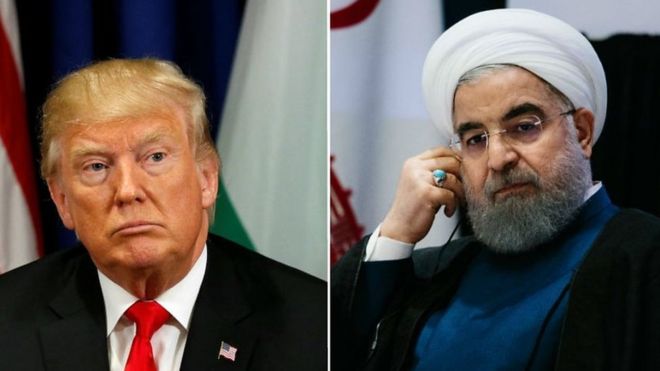
President Donald Trump is stuck in a political box -- largely of his own making -- on Iran, a predicament that becomes more intractable with each alarming cycle of escalation.
In the aftermath of a sophisticated attack on a Saudi oilfield, Trump is being torn between two political and character traits that are starting to define his foreign policy.
He's desperate to avoid a new Middle East quagmire, but cannot bear to look weak.
"I don't want war with anybody," Trump said Monday before returning to bombast. "We have the strongest military in the world ... we're prepared, more than anybody."
The struggle raging inside the President helps explain the contradictory twists of a session with reporters in the Oval Office on Monday. His remarks left future US strategy opaque. They also underlined how President's plight is the predictable result of his own political choices.
Perched on his yellow armchair, next to the Crown Prince of Bahrain, Trump hardly seemed like a steely commander in chief "locked and loaded" for action -- an image he had promoted in a weekend tweet that put the world on edge.
"I'm not looking to get into new conflict but sometimes you have to," he said.
The man who tweeted in 2014 that "Saudi Arabia should fight their own wars" is now being asked as President to protect a kingdom that won his favor with ostentatious flattery on his first official trip abroad.
Hinting at this dilemma, Trump made clear that he had not made any promises to the Saudis, but added in a less than ringing assurance to an ally to which he has synced US foreign policy, "we will work something out with them."
Asked whether Iran was behind the attack, Trump said: "It's looking that way."
Yet moments later, he rebuked a reporter who sought clarification, saying: "I didn't say that."
After a day of lurching political messaging, the impression Trump sent the world was of a President playing for time, keen to preserve off-ramps for himself, and downplaying a crisis that rocked oil markets, could stunt global growth and traumatize the economy he needs to ride to reelection if it gets any worse.

The same forces that prompted the President to suddenly call off an attack on Iranian targets in June to avenge the downing of a US drone over the Gulf of Oman seem to be in play now.
In other circumstances, the President might be praised for taking a prudent course in fully investigating the situation before considering military options.
Yet Trump's aggressive tweets and Secretary of State Mike Pompeo's rush to blame Iran forfeited the benefit of the doubt.
Pompeo further boxed in his boss over the weekend, tweeting that Tehran had "launched an unprecedented attack on the world's energy supply."
Perhaps seeking to create some diplomatic space, Trump sowed confusion on Monday.
"I think I'll have a stronger message or maybe no message at all when we get the final results of what we're looking at," he said. "You know there's no rush."
The choices before Trump are unattractive -- reflecting the complexity of the presidency -- a reality he rarely embraces.
A US official told Press that the US has assessed that the attack originated from inside Iran. The official spoke on condition of anonymity given a lack of authorization to talk to the press.
The administration has so far offered no public evidence of Iranian culpability in an attack claimed by Tehran-backed Houthi rebels in Yemen.
If Iran is at fault, and Trump does nothing, he will look like a paper tiger who makes toothless military threats. Such an outcome would embolden Iran and suggest that behavior that holds the global economy hostage will be met with impunity.
Republican Sen. John Thune of South Dakota said Monday that while the facts of the Saudi attacks are not yet clear, the possibility that the US could respond with force "needs to be on the table."
"To have a credible deterrent against future bad behavior, they have to believe that's a possibility," he said.
The President's discomfort can be explained by the likely disastrous consequences of war with Iran.
Hostilities would confound a Trump 2016 campaign trail promise to avoid foreign entanglements. US troops in the region could be sitting ducks. Allies like Israel and Saudi Arabia would be in the firing line.
And then there is the economic blowback, which could imperil Trump's 2020 reelection campaign.
Comments
Post a Comment